

DAKAR RALLY 2027
— The World's Toughest Race
Everything you need to know about the Dakar Rally 2027 dates, route, categories, costs and how to get to the start line.
Written by people who have been there.

What is the DAKAR RALLY?
The Dakar Rally is the world's most demanding off-road endurance race. Held annually in January in Saudi Arabia and organised by ASO (Amaury Sport Organisation), it covers approximately 7,000 to 8,000 kilometres over three weeks — through dunes, rocky plains, dry riverbeds and some of the most remote terrain on the planet.
Unlike conventional circuit racing, the Dakar Rally is a multi-stage rally raid. Navigation is as critical as speed. Competitors — ranging from professional factory teams to amateur adventurers — must find their way through vast desert landscapes using a roadbook, while managing their vehicle, their pace and their energy across more than a dozen stages.
The rally is open to motorcycles, cars, side-by-side vehicles (SSV) and trucks. Each year it attracts around 400 to 500 entries from over 60 countries. Since its move to Saudi Arabia in 2020, the event has grown in scale and complexity — offering new terrain, longer transfers and increasingly technical navigation.
The Dakar Rally is not won by the fastest driver alone. It is won by the driver who is fastest, most precise, best prepared — and still standing at the finish.
DAKAR RALLY 2027
- Key Facts
-
Date: January 2 – 16, 2027
-
Location: Saudi Arabia
-
Duration: Approximately 3 weeks (14 race days)
-
Total distance: Approx. 7,000–8,000 km
-
Special stages: Approx. 5,000 km timed
-
Categories: Motorcycles, Cars, SSV, Trucks, Classic, Mission 1000
-
Organiser: ASO — Amaury Sport Organisation
-
Entries: Approx. 400–500 vehicles
-
Countries: 60+
-
First edition: 1979 (Paris to Dakar)
Full event details and stage-by-stage breakdown on the official Dakar Rally website
DAKAR RALLY vs. Dakar Classic
What's the Difference?
The Dakar Rally and the Dakar Classic take place at the same time, in the same country, and share the same bivouac. But they are two fundamentally different competitions.
The Dakar Rally is a speed race. The fastest crew across all stages wins. Factory programs from Toyota, Ford, Dacia and Mini compete in cars — vehicles built specifically for the event, with budgets running into millions. On motorcycles, Red Bull KTM Factory Racing and Monster Energy Honda HRC dominate the field.
The Dakar Classic is a regularity rally. It's not about being the fastest — it's about hitting a prescribed average speed as precisely as possible, stage after stage. Vehicles must have been produced before 2005, making it a celebration of classic rally machinery. The Peugeot 405, the Mitsubishi Pajero, the Land Rover Defender, the Toyota Land Cruiser — these are the icons of the Dakar Classic.
For many participants, the Dakar Classic is the more accessible and more emotionally rewarding experience. You race alongside history — sometimes next to the very vehicles that competed in the original Paris-Dakar editions.
→ Want to know more? Read our complete guide to the Dakar Classic 2027.
The History of the
DAKAR RALLY
The Dakar Rally was born from a moment of being lost in the desert.
In 1977, French motorcyclist Thierry Sabine became disoriented in the Libyan desert during the Abidjan-Nice Rally. Rather than a traumatic experience, it became an inspiration — a race that would cross continents, test man and machine to their absolute limits, and celebrate the spirit of adventure. Two years later the first Paris-Dakar Rally left the French capital and wound through Europe and North Africa before reaching Dakar, Senegal.
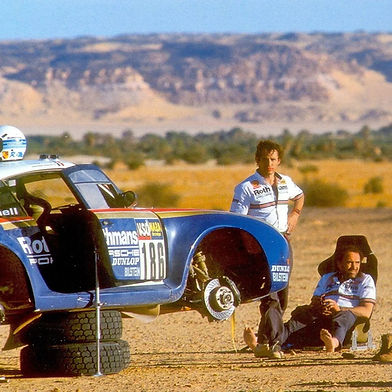
Through the 1980s and 1990s the race grew into a global phenomenon. Factory teams from Peugeot, Mitsubishi and Citroën competed alongside thousands of amateur adventurers. In 2009, security concerns forced a move to South America. In 2020, the rally moved again — this time to Saudi Arabia, where it has been held every January since.
Today the Dakar Rally attracts around 400 to 500 entries from over 60 countries. Professionals and amateurs share the same bivouac, the same dunes and the same singular challenge.
Dakar Rally Categories
The Dakar Rally is open to several vehicle categories — from factory motorcycle teams to classic cars from the original Paris-Dakar era. The main categories are motorcycles (RallyGP, Rally2, Original by Motul), cars (T1 Ultimate, T2 Stock), lightweight prototypes (T3 Challenger), side-by-side vehicles (T4 SSV), trucks (T5), the Dakar Classic regularity category, and the Mission 1000 class for zero-emission vehicles.
Each category has its own rules, classification and competitive dynamic — making the Dakar Rally one of the most diverse motorsport events in the world.
→ Full breakdown of all Dakar Rally 2027 categories and classes
How to Participate in the DAKAR RALLY?
Participating in the Dakar Rally requires preparation across four areas:
eligibility, registration, vehicle preparation and budget planning.
Eligibility
All participants must be at least 18 years old and hold a valid international cross-country rally licence issued by the FIA (cars and trucks) or FIM (motorcycles). To be accepted, you must prove your competence by completing at least one world-championship-level cross-country rally — such as the Rallye du Maroc — within the two years preceding your application. For motorcycle rookies, completing a Road to Dakar qualifying event is often mandatory.
Registration
Registration is handled through the official Rally Register platform. Applications typically open in spring, with a first compulsory payment due around July. Final payments and documentation must be completed by late October. ASO reviews every application individually — sporting results and track record matter.
Entry fees for the Dakar Rally 2026 were as follows — fees for 2027 have not yet been published:
Entry Fee (2027)
-
Bike: EUR 20'800.00
-
Ultimate / Stock / Challenger / SSV EUR 33'300.00
-
Truck: EUR 46'800.00
All fees include vehicle transport from Europe and back, safety and navigation equipment, fuel during the race and bivouac access from arrival on December 30.
Available discounts — Bike:
-
Legend Bonus (10+ participations): − EUR 900
-
Patronage Bonus — Experienced driver: − EUR 500
-
Patronage Bonus — Rookie: − EUR 1,000
-
Communication Bonus: − EUR 500
Available discounts — Ultimate / Stock / Challenger / SSV:
-
Legend Bonus (10+ participations): − EUR 1,500
-
Patronage Bonus — Experienced driver: − EUR 2,000
-
Patronage Bonus — Rookie: − EUR 3,000
-
Communication Bonus: − EUR 500
Available discounts — Truck:
-
Legend Bonus (10+ participations): − EUR 2,000
-
Patronage Bonus — Experienced driver: − EUR 3,000
-
Patronage Bonus — Rookie: − EUR 3,000
-
Communication Bonus: − EUR 500
Budget
Total costs go well beyond the entry fee. As a rough guide for 2027:
-
Malle Moto (Bike, no assistance): EUR 60,000 – 90,000
-
Assisted Privateer (Bike): EUR 100,000 – 120,000+
-
Privateer Car / SSV: EUR 150,000 – 250,000+

Support team
Most privateer participants work with a professional assistance team for mechanics, spare parts and logistics — significantly increasing finishing odds.
Planning your Dakar Rally 2027 campaign?
Talk to us first.
Whether you need a full assistance team, spare parts logistics or expert advice on your preparation — we are your first call in the Dakar world.
DAKAR RALLY 2027
- Frequently asked questions
Last Update: 27.04.2026