
AT vs MT Tyres for the Dakar Classic: What 13 Stages Really Ask of a Tyre

Ask ten Dakar Classic crews which tyre to run and you will get ten confident answers and at least three different tread types. The AT vs MT tyres debate, all terrain versus mud terrain, is older than the event itself, and most of what you read about it was written for mud, forest tracks and weekend trails. The Dakar Classic is none of those. So let us start from the terrain and work back to the tyre.
The short answer: for most Dakar Classic crews, the deciding factor is not the tread pattern, it is the sidewall. Saudi Arabia is a rock and gravel event with long tarmac liaisons and a limited number of dune sections, so a tyre with a three ply sidewall and good stone ejection matters more than aggressive mud lugs. That points to a heavy duty all terrain or a rugged terrain hybrid for lighter and standard vehicles, and to a mud terrain only where the vehicle is heavy, the driving is hard, or the spare strategy is tight. We explain why below, and which FALKEN WILDPEAK covers which case.
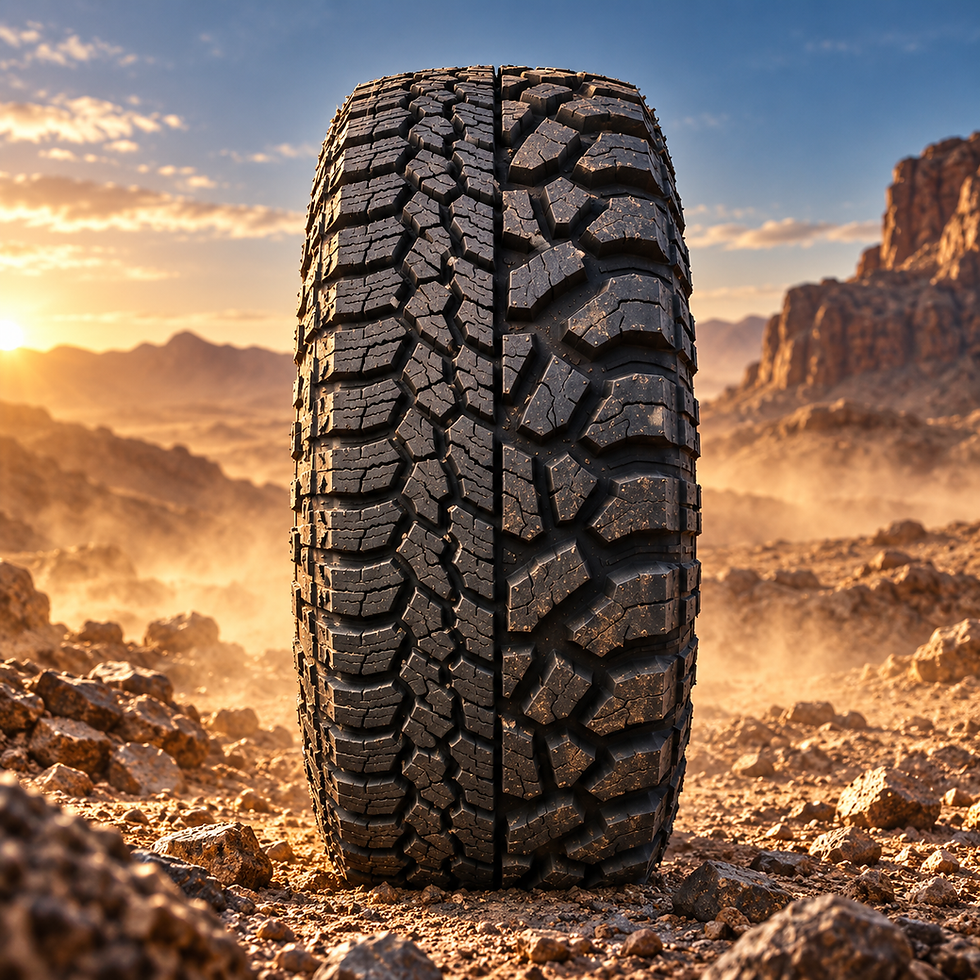
What the Dakar Classic Actually Does to a Tyre
The Dakar Classic 2027 runs 13 stages between 30 December 2026 and 15 January 2027, and it is a regularity event, not a race against the clock. Average speeds are lower than in the Ultimate class, but the ground is the same. A team that finished the 2022 edition put it plainly: compared with the main event, the Classic runs on less sand and on more off piste and rocky tracks.
That is the pattern we see every year from the bivouac. The tyre killers on the Classic are, in order:
Sidewall cuts. Sharp limestone and flint on wadi crossings and rocky plateaus. A cut sidewall cannot be plugged, that tyre is finished.
Heat. Long, fast gravel pistes in the afternoon, often with pressures that were dropped for a sand section earlier and never brought back up.
Impact damage. Hidden rocks in soft sand and washouts on fast tracks that pinch the tyre against the rim.
Wear. Tarmac liaisons add up over two weeks. A tyre that scrubs badly on the road is a tyre you replace at the rest day.
Mud is not on the list. Neither is deep clay or forest ruts, which is what mud terrain tyres are designed for. That single observation reframes the whole debate.
There is also a regulatory angle. The Dakar Classic technical regulation does not allow spare wheels on the roof, so every spare you carry costs you interior or load bay space and adds weight low in the vehicle. The fewer tyres you destroy, the fewer you need to carry, which is why puncture resistance is worth more than any other single tyre property on this event.
The Case for an All Terrain Tyre
A modern all terrain has a closed tread with a moderate void ratio, which gives it three real advantages on the Classic. It runs quieter and cooler on the liaisons, it wears far better on tarmac, and it floats better on sand because it does not dig. Fuel consumption is lower too, and on an event where the regulation demands a minimum range of 350 kilometres plus reserve, that is not a detail.
The weakness of the classic all terrain is the sidewall. Many light truck all terrains are built with two plies, which is fine for gravel roads and disappointing on a Saudi rock field. This is where the FALKEN WILDPEAK A/T AT3WA sits on the sturdier end of the category: an aggressive upper sidewall design, rigid tread blocks, a silica compound for even wear, and the widest size range of the three tyres in this article with 44 sizes from 15 to 22 inches. It also carries the 3PMSF snowflake, which matters if you drive your Classic car to the shipping port in a European December.
Our take: on a standard weight Toyota Land Cruiser or Mitsubishi Pajero driven with regularity discipline, a heavy duty all terrain is a sensible primary tyre, provided you carry at least two full spares and treat pressures seriously.
The Case for a Mud Terrain Tyre
Now the other side. The reason experienced crews still bolt on mud terrains for Saudi Arabia has nothing to do with mud. It is the carcass. Mud terrain tyres are built for abuse, and that construction is exactly what a rock field rewards.
The FALKEN WILDPEAK M/T MT01 is a good example of what that means in practice: a DuraSpec three ply sidewall, offset shoulder blocks that grip on the edge of a rut, a rock and mud function that keeps stones from wedging between the blocks, and an aggressive upper sidewall that takes the hits an all terrain would not survive. It carries the POR marking for professional off road use across all 12 sizes, from LT235/85 R16 to 35x12.5 R17.
The M/T has a Dakar Classic record you can check. In 2022, the Portuguese team Alves Bandeira/TH Trucks ran a WILDPEAK M/T in 245/75 R16 on an ex works Ssangyong Musso, covered around 7'500 kilometres including 2'612 on special stages, and finished without a single puncture. The driver, Joao Costa, said he was sceptical before the event and that "after Stage 2 I knew it was a good choice". We were not that team's assistance crew, but the result is documented and it matches what we see: the crews with the fewest tyre problems are almost always running the strongest sidewalls, not the cleverest tread.
The price you pay for the M/T is on the liaisons. More noise, more heat, more wear on tarmac, and a tendency to dig in soft sand if you leave the pressure high. On a heavy H4 Land Cruiser or a fully loaded 110 with a roof tent worth of kit inside, the trade is often worth it. On a light car with a careful driver, it can be more tyre than you need.
The Third Option: Rugged Terrain
For a long time the choice was binary. Since 2024 it is not. FALKEN launched the WILDPEAK R/T01 as a hybrid that deliberately sits between the two, with a three layer sidewall for cut resistance, offset shoulder blocks with stone ejectors, and a closed enough centre to behave on the road. FALKEN calls it their top model for off road use, it carries the POR marking, and it is available in nine sizes from 16 to 20 inches.
For the Dakar Classic, this is the tyre we would look at first on most vehicles. It answers the sidewall question the way a mud terrain does, and it answers the liaison and sand question the way an all terrain does. Its only real limitation is the size list: there is no 15 inch option, so a Lada Niva or a small early Pajero stays with the A/T or the M/T.
Which WILDPEAK for Which Vehicle
Every tyre choice starts with the size on your registration and the load index your vehicle needs, so check the product page for your exact size before anything else.
As a starting point for the vehicles we see most often at the Classic:
Toyota Land Cruiser (HDJ80, HZJ78 and similar, H2 to H4). Heavy, torquey, and usually loaded. The R/T01 where your size exists, the M/T MT01 if the car is at the upper end of the weight scale or the driver likes to attack.
Land Rover 109 and 110. The 235/85 R16 that many owners run in place of the original 7.50 R16 is covered by the M/T MT01. For a lighter series vehicle driven for consistency, the A/T AT3WA is a valid choice.
Mercedes G. The R/T01 is an original equipment fitment for Mercedes in some markets, which tells you where FALKEN sees it. A natural match for a G Class Classic entry.
Mitsubishi Pajero. A frequent sight on the Classic entry list, and usually one of the lighter cars. The A/T AT3WA or the R/T01 depending on size and how hard you drive.
AT vs MT Tyres: How We Would Decide
If you want a simple decision path, use this one:
Weigh the car as it will start the rally. Fuel, spares, tools, crew. Over roughly 2.5 tonnes, the sidewall argument wins and you go M/T or R/T.
Be honest about your driving. Regularity rewards smoothness. A smooth driver on an A/T finishes; an aggressive driver on an A/T changes tyres.
Count your spares. Two full spares is the practical minimum. If you can only fit two and you are on a two ply tyre, that is a risk you are choosing.
Plan your pressures. Dropping pressure for sand and forgetting to bring it back up for rocks is the most common self inflicted tyre failure we see. Write it into the road book notes.
Why We Are Writing This Now
FALKEN is TimeOut Racing's tyre partner for the Dakar 2027. We say that openly, and we also say the other thing openly: our crews have not yet run these three tyres in a Dakar Classic. The advice above is built on what we have watched happen to tyres in the bivouac since 2022, on the published 2022 result, and on the construction of the tyres themselves.
After the Dakar 2027 we will publish what actually happened on our clients' cars, stage by stage, pressures included. If you are preparing an entry and want to talk through your tyre and spare strategy for your specific car, that conversation is part of what we do during the preparation phase with every crew.
Frequently Asked Questions
Are all terrain tyres good enough for the Dakar Classic?
Yes, on a standard weight vehicle driven with regularity discipline, provided the tyre has a reinforced sidewall and you carry at least two full spares. Two ply all terrains are the tyres we see fail most often.
Do I need mud terrain tyres for the Dakar?
Not for the mud, there is none. Mud terrain tyres earn their place on the Classic through their three ply sidewalls and stone ejection on rock fields. Heavy or hard driven vehicles benefit most.
What is a rugged terrain tyre?
A hybrid between all terrain and mud terrain: a mud terrain sidewall and shoulder with a closer centre tread for road manners. The FALKEN WILDPEAK R/T01 is the current example, launched in 2024 in sizes from 16 to 20 inches.
How many spare tyres should I carry at the Dakar Classic?
Two full spares is the practical minimum. The technical regulation does not allow spare wheels on the roof, so they have to fit inside or on a carrier, which is a strong argument for a puncture resistant tyre.
What tyre pressure do you run at the Dakar Classic?
It depends on tyre, vehicle weight and terrain. The principle is more important than a number: lower for sand, back up for rocks and fast pistes, and never leave a sand pressure in the tyre on a hot afternoon gravel track.
Which FALKEN tyre did the 2022 Dakar Classic finisher use?
The Alves Bandeira/TH Trucks team ran the WILDPEAK M/T in 245/75 R16 on a Ssangyong Musso and finished the 2022 event with zero punctures over roughly 7'500 kilometres.
About the Author
Sven Syfrig is the founder and Team Principal of TimeOut Racing, a rally raid assistance team based in Switzerland. Founded in 2014, the team has supported private crews at the Dakar and Dakar Classic every year since 2022, including five crews at the Dakar Classic 2026, with more than 660 mechanic hours spent under clients' cars in the bivouac. Sven writes from the place most reports never reach: the bivouac at three in the morning.
Comments